
Finding product–market fit is treated as the hard part. Repeating it on purpose, month after month, is harder.
The third edition of Studio Connect took on the question that follows PMF: what turns revenue from a series of wins into a system. Not a sales target and not a growth plan — an operating system, with inputs that can be observed and levers that can be pulled.
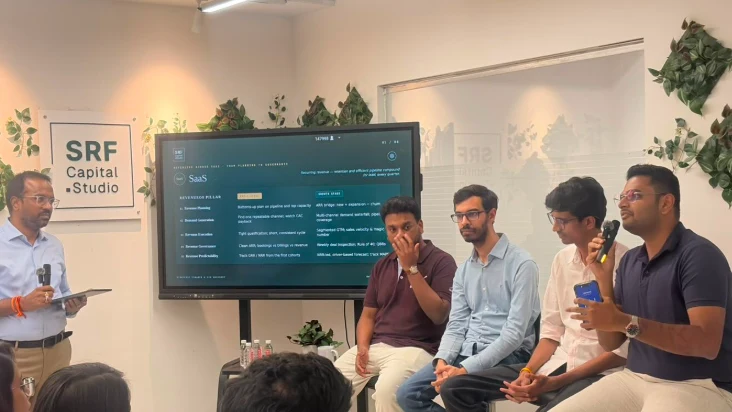
So SRF Capital Studio hosted Studio Connect: Revenue Operating System — and deliberately put four different business models in the same room, because the answer is not the same for all of them.
Why a Revenue Operating System Matters
Revenue that cannot be explained cannot be repeated. And revenue that cannot be repeated is very difficult to fund, to hire against, or to build a plan on.
What separates the two is rarely effort. It is whether the business knows which inputs produce its revenue — and whether it is managing those, or managing the number itself.
Key Themes Discussed During the Session
Deeptech: Revenue on a Long Clock
In deeptech the gap between a product that works and a product that sells is measured in years, not quarters. Commercialisation is its own discipline, and the sales cycle is long enough that pipeline maths built for software simply does not hold.
Predictability here comes from knowing who signs, how long their process takes, and what has to be true before a pilot becomes a contract.
Consumer: The Economics Underneath the Growth
A consumer business can grow revenue quickly and still not have a revenue engine, because growth bought at the wrong unit economics reverses the moment the spend stops.
The discussion turned on the numbers that decide whether D2C revenue compounds or merely repeats: what it costs to acquire a customer, what that customer is worth, and how the gap between the two is funded.
SaaS: Recurring Revenue and Growth Efficiency
Recurring revenue is the closest thing to predictable revenue by construction — but only if retention holds and the cost of growth is falling rather than flat.
Efficiency, not top-line, is what turns a SaaS revenue line into something an investor will underwrite.
Manufacturing: Capacity, Utilisation and Margin
In manufacturing the revenue question is a capacity question. Utilisation and margin decide whether an order book is worth having, and both are set by decisions made long before the order arrives.
It is the clearest version of the evening’s argument: revenue is an output of how the business is run, not a target set independently of it.
Voices from the Ecosystem
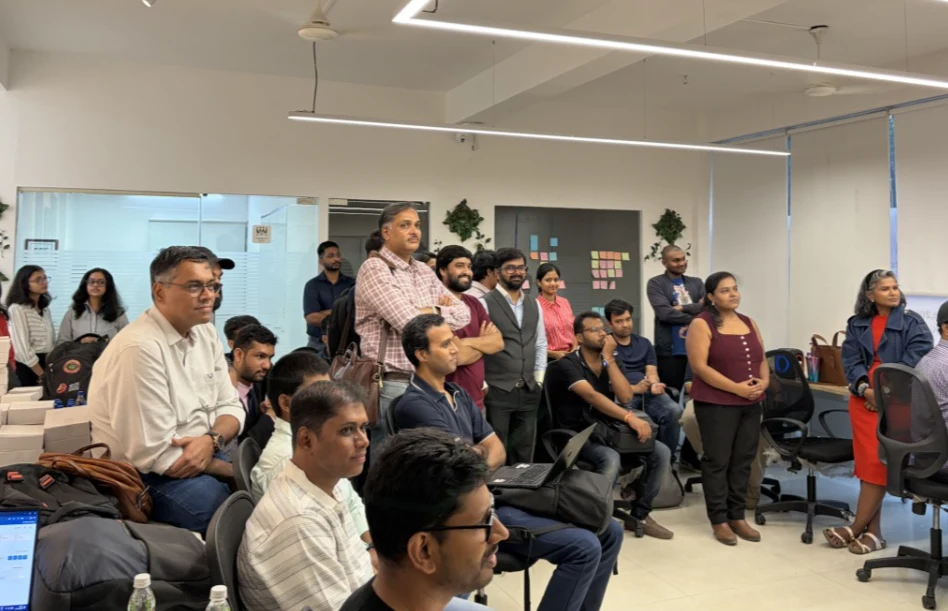
Four panellists, four business models, one question:
- Anoop MohanDeeptech — commercialisation and long sales cyclesBluehill.VC
- Akshit KhanijoConsumer — D2C economics12 Flags
- Nikhil BisaniSaaS — recurring revenue and growth efficiency3one4 Capital
- Anirudh SiddharthManufacturing — capacity, utilisation and marginsCapital-A
